
Experience Design: The Part of a Wedding You Cannot Photograph
Something has shifted in how people talk about weddings. There is far more conversation now about how a celebration feels to be inside, rather than simply how it photographs, about guest experience, atmosphere, and the memories people carry home long after they have forgotten the centrepieces.
It is often discussed as a new idea. I don't think it is. Designing how a wedding feels is a craft with real techniques, real decisions and real trade-offs, and much of it happens in the parts of a weekend nobody thinks to plan. I have been designing weddings this way for years. Here is what that actually involves.
The Feeling Lives Between The Moments
It is easy to create a beautiful room, an exciting moment, a breathtaking reveal. Any good supplier can deliver one of those. But a wedding is not only a collection of beautiful moments, it is the movement between them - the arrival, the gathering, the transitions, the way guests are carried through a weekend without ever once wondering where to go or waiting for something to happen.
I call this the invisible architecture of a wedding day. Guests never see it, and that is the point. What they experience instead is a strange and lovely sensation: everything simply happens, at the right time, in the right order, and they are always exactly where the day wants them to be. Ask them afterwards what made the wedding so good and they will struggle to name it. They felt looked after. They felt the weekend carried them. That feeling is not an accident, and the atmosphere alone does not create it. It is planned, to the minute, and then hidden.
What That Looks Like in Practice
Let me give you a real example. At a recent wedding, the couple had one wish for the moment guests moved from cocktails to dinner: they wanted it to happen inside a single piece of music. The song would begin live on harp in the main house, with a violin joining partway through, and by the time guests arrived in the banqueting hall - a separate building across the courtyard - the live music would meet the recorded version already playing inside, without a seam.
This may sound simple. It is not. You cannot perfectly synchronise live music in one building with a recording in another. And you certainly cannot control exactly how quickly a crowd of guests will cross a courtyard. So the transition had to be built around the one variable we could control: the violinist's walking pace. A gong gathered everyone's attention. The harp opened from the balcony. The violinist descended the stairs dramatically and led guests out through doors opened at exactly the right moment, controlling the pace of the walk so that she arrived at the banqueting hall at the precise bar of the song where the recorded version could take over. She paused, nodded, the doors opened, the recording came in at the exact timestamp, and her violin rejoined on top of it as guests walked into the room - so the sound never broke, and the moment felt cinematic rather than managed.
Nine steps, two musicians, one sound engineer, four coordinators, two buildings, and a document that choreographed all of it down to who opened which door. The guests experienced about ninety seconds of magic.
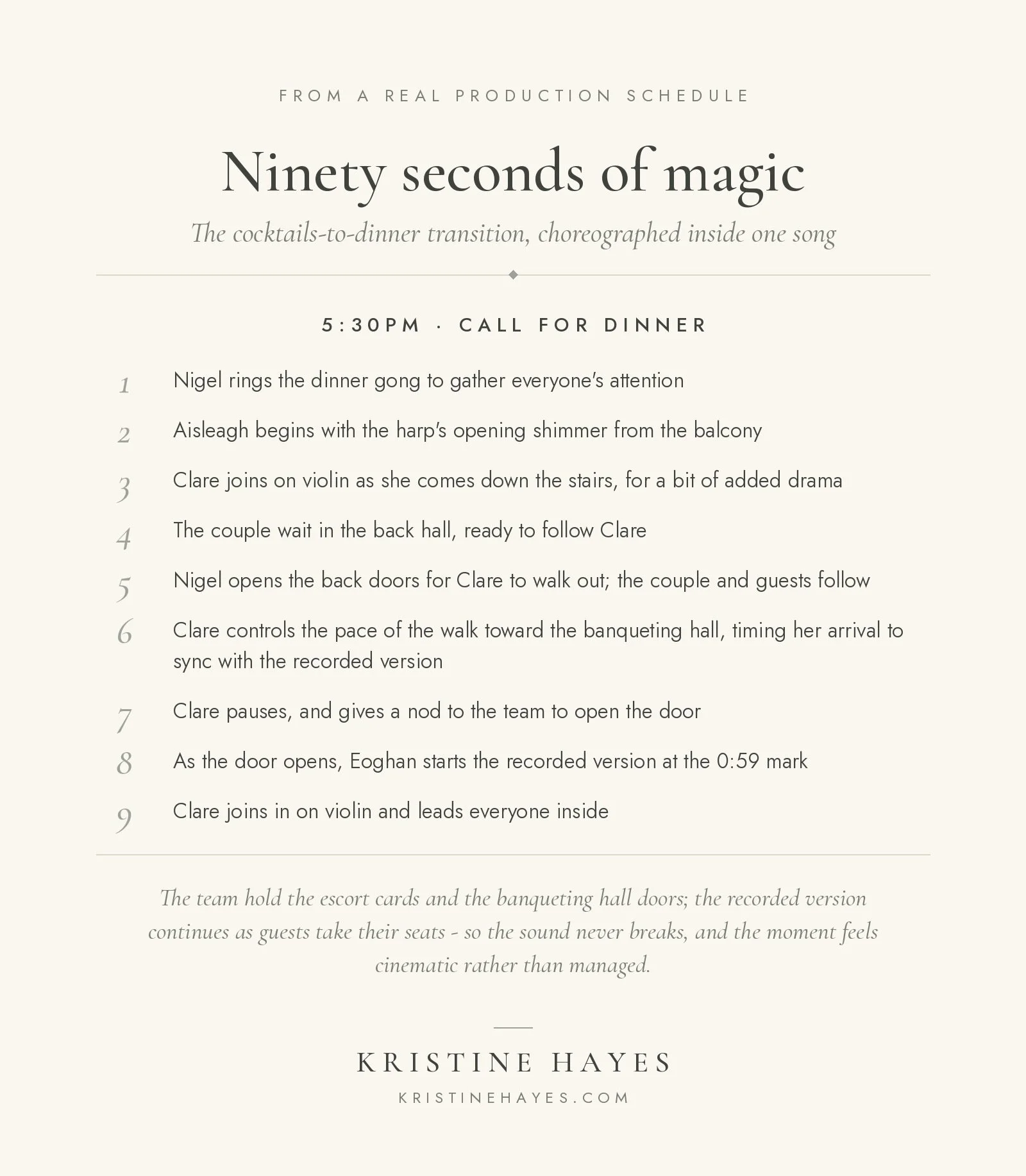
That is experience design, An enormous machinery in service of a feeling that seems effortless.
A Gap is Never Filled, it is Given a Purpose
Every wedding day contains structural gaps - the room turnaround, the band setup, the movement between events, the space between dinner and dancing. The traditional approach is to let guests wait, and the slightly better approach is to fill the gap with generic entertainment. Neither is good enough, because guests can feel the difference between being parked and being hosted.
The principle I work to is this: a gap is never filled, it is given a purpose - and the best purposes are personal. At one wedding at Mount Juliet, where every event shared a single space, the room turnaround became the moment the bride's father shared the speciality tequila he had brought for exactly this occasion, while guests took Polaroids of each other for the couple's album. Nobody waited for anything. They were at a tequila tasting hosted by the father of the bride, and the room quietly transformed behind them. At a castle wedding, the entire party will step outside to cut the cake under fireworks while the dinner room turns into a dancefloor behind closed doors.
Same machinery, different weddings, one rule: the guest should never be aware that the schedule needed something from them.
Feeling is Not The Opposite of Beauty
I want to be careful here, because the experience era is sometimes framed as a rejection of design - as if caring how a wedding feels means caring less how it looks. In my work it is precisely the opposite. I came to planning through design. I trained in interior design and worked in florals and styling long before my work expanded into running entire wedding weekends. The design is not competing with the experience. The design is one of the instruments that creates it.
A palette drawn from the room itself settles the space where guests will linger. A layout makes the way forward obvious without a single sign. Candlelight is placed for the hour when the light changes and everyone is finally seated and slowing down. The reveal is timed so no one ever sees it being built. None of it is just decoration. It is the architecture of a feeling - and this is why I have never believed a planner should choose between being design-led and being experience-led. Aesthetics and experience are the same discipline, practised at the same time, by the same hand.
Why This Works So Well in Ireland, And Over a Weekend
A single wedding day gives you perhaps twelve hours to create a feeling. A destination weekend in Ireland gives you three days: a welcome evening with its own tone; a wedding day that builds, softens and builds again; and a final gathering that begins slowly before finding its own energy. Each event has a different rhythm, but the arc between them is designed too: how the weekend opens, how it gathers and how it closes. Guests leave not with memories of a wedding but of a shared experience they were part of from the first drink to the last farewell.
Ireland is unusually generous to this way of working. Exclusive-use houses and castles mean the whole world of the weekend belongs to your guests. No check-ins or check-outs on the wedding day itself. The house, the gardens, the rooms between rooms - all of it becomes the stage for the moments between the moments.
The Honest Cost of Ease
The last thing worth saying is the least romantic. Seamlessness is not a vibe; it is a resource. It takes suppliers who work as one team, contingency plans that guests never learn existed, and enough production capacity that nothing has to happen in front of the people it should be invisible to. This is, honestly, why I love working at the top end of the market - not for the scale of the flowers, but because it is where true ease becomes possible to build, guest experience is truly protected, and the behind-the-scenes can stay entirely behind the scenes.
Luxury is not excess. It is ease. And ease, it turns out, is the most designed thing at the entire wedding.
---
Kristine Hayes is a destination wedding planner and designer based in Ireland, creating multi-day celebrations built around guest experience, seamless flow, and design drawn from Ireland's finest venues. If you are planning a wedding weekend in Ireland, get in touch.